Showing posts with label innovation. Show all posts

Sunday, October 3, 2010

Mind Mapping in the Modern Age

Originally pioneered by Tony Buzan, a Mind Map is a type of diagram that is a radial organization of an outline. Mind Mapping is taught in prestigious schools such as MIT.

I like mind mapping. I have always believed that diagrams are the instrument of thought and the mind map is a great diagram for composers of all types or simply for those wishing to organize their ideas.

Here is my short list of open source mind mapping tools that are thriving in 2010.
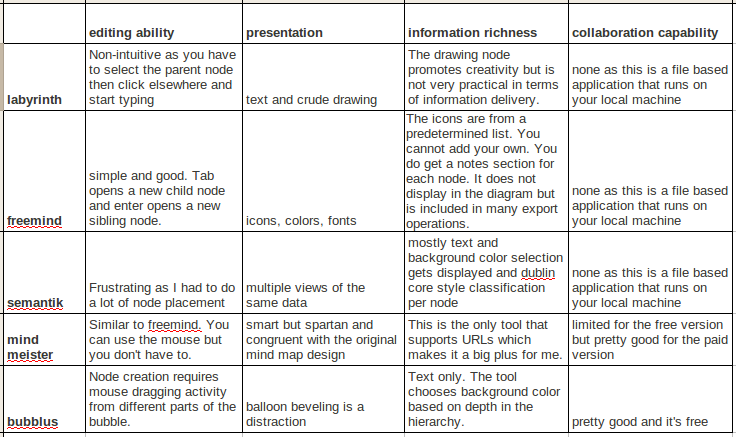
Summary of Mind Mapping Tools Compared

Labyrinth is a Gnome tool so it is for Linux users only. Labyrinth can be easily installed from the Ubuntu software center. It's not the best tool by far but I end up using it because mind maps created in Labyrinth can be indexed by the search tool Beagle. Here is a screen shot of a labyrinth mind map of this very blog.
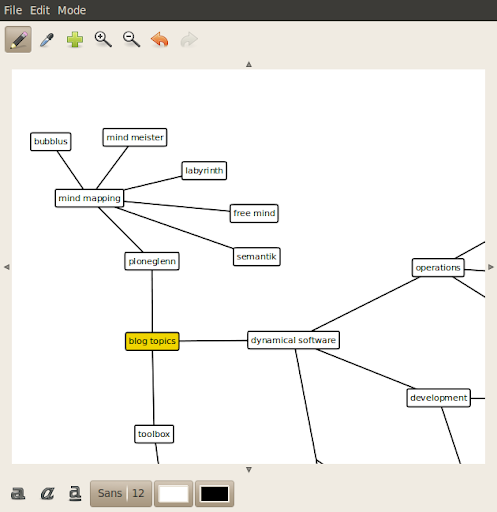
Labyrinth Screen shot

Freemind is a great stand-alone tool for mind mapping. The GUI doesn't get in the way of your creativity. Freemind is written in Java so it can be run from Windows, Mac OS X, or Linux. Files saved in one OS can be opened in another.

Semantik is written on top of KDE so it is another Linux only tool. It's focus is to aid students in generating documents based on mind maps. Semantik can also be easily installed from the Ubuntu software center.

You don't install Mind Meister on your local machine because it is a web application that you access through your browser. Mind Meister stays true to the original concepts of mind mapping yet extends those ideas in useful and relevant ways. Mind Meister is a commercial company based on the freemium model so you don't get to fully access all the features without paying a monthly subscription.
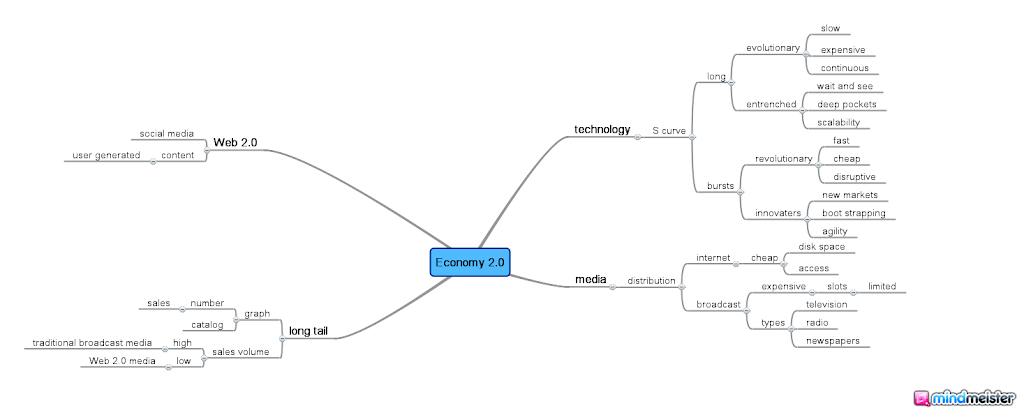
Mind Meister diagram exported as a PNG file

At first glance, Bubblus diagrams don't look all that much traditional mind maps. Like Mind Meister, Bubblus is also a web application that you do not install on your local machine. Unlike Mind Meister, Bubblus is free forever so you get full access to all of its features without a monthly subscription fee.
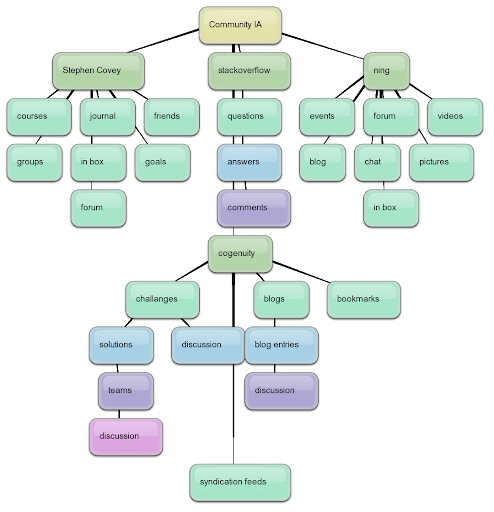
Sample exported Bubbleus diagram

Mind mapping is a great way to explore the hierarchy of ideas through creative diagramming. These five free tools present the state of computer based mind mapping in 2010.

Sunday, January 17, 2010

The Flat Enterprise Society

My company has a few collaboration products (Code-Roller and Cogenuity) so I often write about ECM because it is an exciting industry to be in these days.

Enterprise Collaboration is exciting in terms of growth but it is also exciting because its thought leaders have something interesting to say. Folks like Thomas Malone, Andrew McAfee, and Dion Hinchcliffe are doing a lot to advance modern corporate tribal thinking to greater levels of democratic culture.

Like any disruptive innovation, change is required in order to realize any benefits. Change has to come from both the board room and the water cooler in order for it to have any lasting effect. True change must come from above and below, from the executives and the rank-and-file. That turning point is what is usually called the watershed moment in the adoption curve of any paradigm shift.

That is why I got excited when I read this NY Times interview of the CEO of SunGard. Cristóbal Conde explains in day-to-day, boots-on-the-ground terms that any C level player can understand how the old ways of top down management simply won't scale in this modern age of global competition, cheaper communications, and the rising price of oil.

Conde does not come off as pompous. He talks about mistakes that he made before he understood the true value of collaboration. Other valid points that he makes include the fallacy of micro-management, the importance of intellectual curiosity, and the mental illness known as PowerPoint. Sounds provocative? Definitely give this one a read.

Sunday, December 27, 2009

3D is the New Talkies

I just watched Avatar last night and it is now clear to me that 3D is the new talkies.

What are talkies, you ask? Whenever a disruptive innovation hits the movie industry and gains traction, it tends to take over the entire industry. This was the case back in the 20's when synchronized sound was added to film. This new type of movie was called a talkie since actor dialog was the new and most salient feature. It happened again in the 50's when color films became mainstream.

It's happening now with 3D in which the viewer uses a specially treated pair of glasses to watch films processed to work with those glasses such that the elements of the film appear to have depth.

It sometimes takes a while for a technology to go mainstream. The first color processing was invented in the 20's and an earlier wave of 3D movies from the 50's died out, primarily because of the more primitive polarization effects used then resulted in eye strain and headaches. That is not the case with modern 3D.

Just like with color, animation and remastering old favorites are early adopters.

Both movie industry equipment vendors and movie theaters are making investments in the technology.

A lot of big name directors are positioning for their first 3D releases. Other applications of the technology are also being explored.

I am already starting to see in video rental that the other side of the disk is the 3D version and half of the previews what I saw when I went to see Avatar were also in 3D.

I've seen the future and it appears to be 3D.

Monday, August 24, 2009

Understanding Google Wave

In late May of this year, Google announced a new technology initiative of theirs called Google Wave. What is this technology about and why should anyone care?

Early reports painted the picture of Google Wave being a hybrid between instant messaging and email with an emphasis on conversant collaboration. Because of that observation, people just thought it was an email killer and Internet attention went elsewhere. After all, who is dissatisfied with email?

Since then, many Internet pundits have weighed in on the subject. Some claim that it is too complicated for rapid adoption. Others see it more as a platform for enterprise collaboration than as an email killer.

Google Wave is scheduled to expand its beta audience in about a month from now. Many sources are now skeptical about whether or not the technology is stable enough to take that step.

So, why should you care? Whether or not Google can make its commitment by the end of the week is immaterial to me. What is important is that if they can carry this off and deliver on the promise of Google Wave, then I believe Google Wave can be a dramatic game changing innovation to those web properties that thrive on user generated content.

But innovation is not always well received nor easy to accept. I will go into more details about this in a future post but what Google Wave empowers is real-time conversations across multiple web properties. Imagine a world where discussion threads are transformed into persistent chat rooms that cluster around a particular topic instead of belonging to a particular article or blog entry. Each web page devoted to that topic could share in the discussion yet the participants could also track the complete conversation in a web GUI that does look like email on steroids.

So, what's the problem? What's the big deal? This means that web properties are going to have to be ready to let go of some traffic away from their site in order to open their site up to more traffic from other sites. This philosophy runs counter to the current practice of stickiness where web sites do anything to capture and retain visitors to their site.

I'm a big advocate of sharing information online as a necessary step to fostering healthy and prosperous communities of practice so here's hoping that this wave is one that catches on. Stay tuned for more developments in September.

Sunday, November 9, 2008

Innovation During a Global Recession

I read in the previous Sunday edition of the NY Times an opinion piece called It's No Time To Forget About Innovation.

Author Janet Rae-Dupree uses material from the following two books to further her advice not to completely stifle innovation during these economic hard times; Closing the Innovation Gap by Judy Estrin and Strategic Entrepreneurism by Jon Fisher.

According to Janet, Judy posits that the following core values need to be in equal balance in order to foster innovation; questioning, risk taking, openness, patience, and trust. You may have heard of this as failing fast, From the Outside In, and the long tail. She also advocates "green thumb leadership" where gardens of new ideas are permitted amidst the factory farms.

Contrast this with Jon's position that innovation must be embedded in the daily operation of the rank and file. Entrepreneurs should plan their start in a highly creative and innovative environment then sell the business to a larger, more established company in order to scale up.

I think that what most of these people are trying to say is that innovation, by and of itself, is not optimized for making money; however, innovation can open the door to profitable markets in the future. It would seem to me that the best time to focus on not making money is when there is not that much money available to be made. So, the best time to innovate is during a global recession. It's not like your competitors are going to raise their market capitalization by improving their profitability while you fritter away in the lab.

Of course, I'm not saying that you should throw huge amounts of money at it. Innovators work best when they are hungry. That's another reason why this is a good time to innovate. Think Guy Kawasaki's boot strapping.

To that end, I invite all innovators to join a newly formed and emerging community devoted to innovation on a budget. Code Roller is a place where entrepreneurs and engineers get together to produce the next generation of great applications for the web. Code Roller is a collaborative software development project life cycle management solution that combines time honored, best-of-breed deliverables and work flow with state-of-the-art techniques in social networking and crowd sourcing to deliver custom software faster, cheaper, and better by accelerating discovery. The use of Code Roller is free.