Showing posts with label pattern recognition. Show all posts

Sunday, October 3, 2010

Mind Mapping in the Modern Age

Originally pioneered by Tony Buzan, a Mind Map is a type of diagram that is a radial organization of an outline. Mind Mapping is taught in prestigious schools such as MIT.

I like mind mapping. I have always believed that diagrams are the instrument of thought and the mind map is a great diagram for composers of all types or simply for those wishing to organize their ideas.

Here is my short list of open source mind mapping tools that are thriving in 2010.
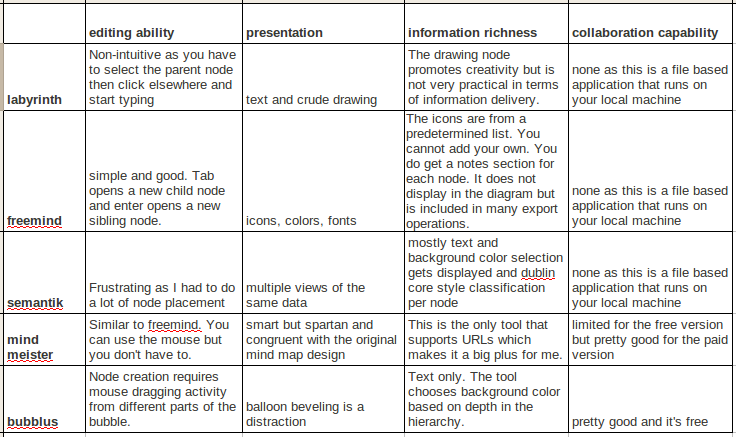
Summary of Mind Mapping Tools Compared

Labyrinth is a Gnome tool so it is for Linux users only. Labyrinth can be easily installed from the Ubuntu software center. It's not the best tool by far but I end up using it because mind maps created in Labyrinth can be indexed by the search tool Beagle. Here is a screen shot of a labyrinth mind map of this very blog.
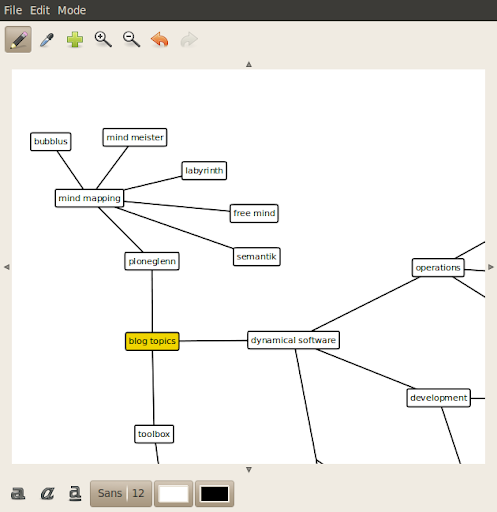
Labyrinth Screen shot

Freemind is a great stand-alone tool for mind mapping. The GUI doesn't get in the way of your creativity. Freemind is written in Java so it can be run from Windows, Mac OS X, or Linux. Files saved in one OS can be opened in another.

Semantik is written on top of KDE so it is another Linux only tool. It's focus is to aid students in generating documents based on mind maps. Semantik can also be easily installed from the Ubuntu software center.

You don't install Mind Meister on your local machine because it is a web application that you access through your browser. Mind Meister stays true to the original concepts of mind mapping yet extends those ideas in useful and relevant ways. Mind Meister is a commercial company based on the freemium model so you don't get to fully access all the features without paying a monthly subscription.
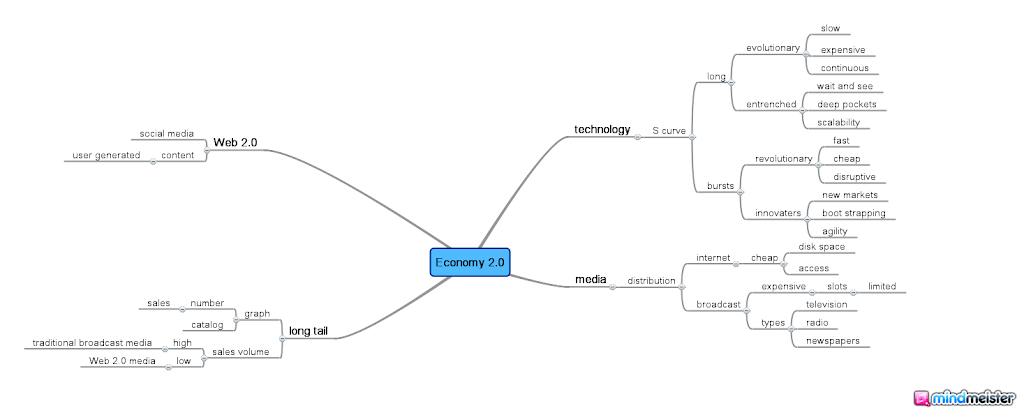
Mind Meister diagram exported as a PNG file

At first glance, Bubblus diagrams don't look all that much traditional mind maps. Like Mind Meister, Bubblus is also a web application that you do not install on your local machine. Unlike Mind Meister, Bubblus is free forever so you get full access to all of its features without a monthly subscription fee.
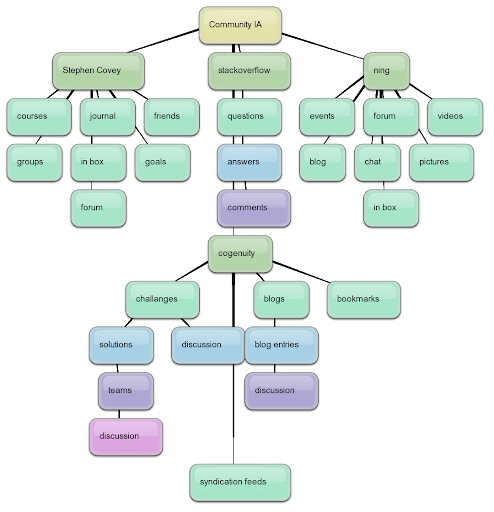
Sample exported Bubbleus diagram

Mind mapping is a great way to explore the hierarchy of ideas through creative diagramming. These five free tools present the state of computer based mind mapping in 2010.

Monday, July 30, 2007

There is Neither Beauty Nor Mystery in Ignorance

I subscribe to the American Go E-Journal which sends me email periodically about this ancient, venerated strategic board game. In one of their recent emails was an article called SAVING GO: A Modest Proposal to Programmers (Stop!) where Paul Celmer pleads with software developers to stop trying to create a professional Go playing program. His main arguments are that such a program would "devalue human achievement" and that it would "mar the beauty of our game" by solving its mystery. He claims that this is what has happened to both checkers and chess.

Obviously, Mr Celmer isn't worrying about devaluing human programmer achievement, only devaluing human go player achievement. A professional strength go playing program would be a great human achievement in the fields of software engineering and artificial intelligence. Perhaps we should outlaw cars since they might devalue the achievement of human marathon runners.

I don't believe that professional strength chess programs have solved that game by a long shot. It does look like the best chess players are having more and more difficulty keeping up with the best software systems but those systems are out of reach of the standard consumer. Most professional chess players can hammer the typical consumer grade chess game.

At the same time, software has raised the average of chess competency by allowing students of the game to drill against the computer which is available for them at any time. Before that, they had to sharpen their skills against other humans which took longer because both humans had to schedule time to be available to play.

Mr. Celmer really doesn't have a lot to worry about, however. Last year, the journal on Artificial Intelligence, called IEEE Intelligent Systems, published an editorial called Computers Play Chess; Humans Play Go. Editor James Hendler describes the combinatorics of go as dwarfing that of chess. Also, there is a lot more simultaneous, multivariate pattern recognition in go than there is in chess. Even though the rules of go are simpler than that of chess, the playing of go is much more difficult.

It even takes a while to teach a human the concepts of life and death in go. No-one has successfully programed a computer to always be able to recognize such a simple, fundamental concept as that much less more advanced concepts such as thickness, shape, or the direction of development.

There is go playing software that is useful for drilling and for improving your game. My favorite is an open source game called GNU Go. This software is actually only the artificial intelligent player. You still need software that simulates a go board and the playing stones and that can talk to GNU Go. My favorite open source software for that is Panda-glGo. Even the best go software cannot hope to beat the worst professional player.

I have one last nit to pick about Mr. Celmer's plea. In Mr. Celmer's world, beauty can be marred by solving mystery. In my world that can never be. You see, solving one mystery opens our awareness to a thousand more mysteries, thereby increasing its beauty by three orders of magnitude.